Resonate
    LEAF Racewear
    Resonate Brendel Racing Team: karting, racing
			  software and
			  books, online store, software, links, photos,
                          technology, glossary, team results
    KAM Karting Supply
    Ribtect

    The Internet Karting Glossary
    Definitions: F-R
    Tech logo


    What terms should be added to the glossary? Please tell us!

    If you know of anything we should add, please click on the link above and help us to make this the most comprehensive online karting glossary. If you think we made a mistake somewhere, or you would like to add information to something we have already listed (e.g. the terms defined by ####, meaning they still need a definition), please send us an e-mail directly to racing_at_domain-name-of-this-site.com.


    • Glossary index

    • 2 4 A B C D E F G H I J K L M N O P Q R S T U V W X Y Z

    • Glossary full listing

    • Glossary home


    F:

      Face shield
        Part of the helmet. The clear thingy in front of your eyes. Some may be equipped with tear offs, some may be tinted, etc.

      Fairing

        The body work in front of the driver. The nose cone is part of the fairing, but also the 'driver fairing' which is mounted before the steering column.

      Fins

        Air cooled engines are typically covered with cooling fins. These fins are increasing the surface of the cylinder and cylinder head, which increases the heat-transfer from the engine to the surrounding air.

      Fire extinguisher

        Highly recommended and often mandated. There should be one mounted to every kart stand and in every trailer and workshop. During towing, the extinguisher should not be in the trailer but rather in the towing vehicle, for obvious reasons.

      Flag man

        The race official who is displaying the flags and who has the power to start and stop a race, thus controlling the race. Since he/she is also in control of the black flag it is a good idea to always keep on good terms with that person.

      Flags

        The race officials will communicate with the drivers via flags. Every driver should be familiar with the flags and their meaning used at their track. Flags will be shown by the flag man.

      Flex

        A piece of metal tube with a specific length which connects a pipe style exhaust to the cylinder. The exact length of the flex may vary and affects the driving characteristics. A different track may need a different flex. Hence choosing the right length flex becoms part of the setup.

      Flexing

        In the karting context, flexing is what the frame does when cornering, since there is no suspension on a kart, and there is not differencial on the rear axle. As a result the inner tire in a curve would scrub. The flexing allows the inner tire to slightly lift off the ground, reducing tire scrub. Stiffness, i.e. the flexing ability of the kart, greatly influences the handling and can be changed through various means.

      Formula-Y

        A class of karting which uses the KT-100 engine, sticky tires and a direct drive.

      Frame

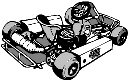
        The frame is where seat, engine, wheels, etc. are mounted on. There are various kart manufacturers which will offer different frames. Depending on who you ask, you will get different suggestions on which frame is the best. Some people claim that European kart frames are better than American ones. This topic is always good for a long and heated discussion among karting fans. The frame is also called chassis. A frame is designed to allow flexing during cornering, which is quite an important point. You might want to read more about the flexing. The constant flexing during cornering will eventually wear out a frame. Because the frame has to work so hard, the younger the frame, the better. Mileage may vary, but don't buy a frame which is older than 5 years, if you plan on being competitive. Older ones are typically quite cheap and will do great to get some first experiences in. To get an overview of just some of the many kart frame manufacturers, click here.

      Front nose

        A piece of the body work of the kart, attached to the front bumper. On most short tracks, on which the karts do not achieve very high speeds, such a nose piece is used for optical reasons, but also to protect the feed of the driver, to prevent the front wheels to touch the rear wheels of another kart, etc. Depending on where you race, a nose piece might be mandated. Check your regulations. For some it is just an optical improvement or a good place to put stickers. Also called nose cone or nose piece.

      Front track

        The distance between the two front wheels. It can be varied by adding or removing the spacers from the spindles. Varying the front track changes the handling of the kart. Front track is part of the setup.

      Fuel

        See gas. The fuel for 2-cycle engine is a gas / oil mixture. The oil is needed to lube the internal components of the engine, since it does not have a separate engine oil system like a 4-cycle engine.

      Fuel filter

        The fuel filter is part of the fuel line. It is a clear piece of plastic, which contains a filtering material. The purpose is of course to prevent any impurities to enter the carburetor.

      Fuel line

        The fuel line connects the tank to the engine. It is typically made of clear, flexible rubber. Somewhere in the middle of the fuel line is the fuel filter. The fuel line should be changed at least once a year. It should be made from non-hardening rubber, and all fuel should be drained out of the fuel system after use.


    G:
      Gapping tool
        A small tools which makes it very easy to measure the gap at the bottom of a spark plug.

      Gas

        It is possible to run 'pump' gas, but most people will use race gas, which has a higher octane level than pump gas.

      Gauge

        A gauge is a device which displayes a mesuremed vale. E.g. the tire pressure gauge. However, in the world of karting, one usually means the displays mounted to the steering wheel when referring to gauges. These particular gauges are most commonly the tach and the temperature gauge, measuring RPM and CHT respectively. These masurements are essential to proper driving and tuning of the kart. Other measurements may be taken as well, e.g. the EGT. Many gauges on the market can display 2 or even 3 values, so that only one unit needs to be mounted to the steering wheel. The most popular brands are Digitron and My-Chron. Such gauges are also referred to as displays. To get an idea about the options and pricing of these gauges, click here.

      Gear

        A term used for various things. Depending on the context, it means the gear ratio or a specific driven sprocket.

      Gear ratio

        The ratio between the sizes of the drive sprocket and the driven sprocket. Different ratios can quickly be set by changing the size of the driven sprocket. In non-shifter karts, this is the only way to change gears. Also called the reduction ratio.

      Gearbox

        The manual transmission on a shifter kart.

      Gloves

        Gloves are a mandatory safety equipment for kart drivers. They are needed to protect the hands in case the driver us ejected from the kart and slides over the ground. Abresion resistant gloves are preferrable, even though this is usually not enforced. The glove should fit tightly. Karting gloves do not need to be fire resistant.

      Governing body

        ####

      Grease

        See lube.

      Grid

        Short for starting grid. The order in which the drivers line up for the race start. This order is usually determined through qualifying. The driver who managed to end up in the first position is in pole position, while the driver on the last spot is simply in a bad position.

      Grip

        The stickier a tire, and the larger the contact patch, the more resistance against scrubbing the tire will have. This means higher cornering speed and acceleration/deceleration. Also called traction.


    H:
      Handling
        The overall driving characteristics of a vehicle. Different handling characteristics may be favored by different drivers or may be necessary for different tracks, track conditions, etc. Handling is influenced by many, many factors, and it is the racer's constant quest to search for the 'perfect' setup which provides the best possible handling, as perceived by that driver. Only some of the factors are: frame, engine, clutch, tires, driver, weight distribution, front track, rear track, etc.

      Head gasket

        ####

      Helmet

        What you wear on your head in order to protect it from crashes, impacts, etc. Even though open face helmets are not illegal, a full face helmet is highly recommended. Acceptable helmets for karting need to be Snell rated, i.e. examined and approved by the Snell Foundation. Currently, helmets which are SA-95 (auto sports), M-95 (motorcycle) or KA (karting) rated will be acceptable. But safety standards will change and you should always check the latest regulation of your standards body. Karting helmets do not need the fire resistant inner lining that is used for many other racing helmets, which significantly increases the price of those helmets.

      High-speed needle

        An adjustable pointed screw in the carburetor, that leans the mixture at high RPM when screwed in, and richens it when screwed out. See needles.

      Honda

        Manufacturer of a 4-cycle engine used in some karting classes.

      Hopping

        A nasty handling characteristic in corners where the rear tires alternately grip, slip, grip, and slip, that causes the chassis to bounce up and down in the turns.

      Horstman

        Manufacturer of a 2-cycle engine, called HPV, used in some karting classes. Also a manufacturer of very common kart clutches.

      Hub

        The hub sits snugly on the axle, and has the wheel rim mounted to it. Essentially, it connects wheels and axle.


    I:
      IAME
        Manufacturer of a 2-cycle engine used in some karting classes.

      Idle setting

        The idle setting determines the RPM the engine will hold on its own, without depressing the throttle. It can be adjusted on the carburetor via the idle adjustment screw.

      Idle adjustment screw

        See idle setting.

      IKF

        International Karting Federation, which is the governing body for most of the karting going on in the western part of the US.

      Intake port

        The opening in the engine casing through which the air - fuel mixture (in a 2-cycle engine) is sucked into the cylinder. The carburetor is located in front of the intake port. See also piston skirt.


    J:
      Journals
        Slots in the back of the kart frame in which the axle cassettes for the bearings of the rear axle are mounted.


    K:
      KART
        Karters of American Racing Triad. Governing body for most of the midwest of the US.

      Key stock

        A thin, long metal bar with a square profile, just a few millimeters thick, but usually several inches long. Key stock is used to prevent rotating of brake discs, driven sprocket and wheel hubs on the rear axle. These things which are mounted on the axle have a small groove, similar to the long groove which can be found on the rear axle of a kart. The key stock is inserted there, being half nestled into the groove on the axle, but sticking out far enough to grip on the groove of the hubs, sprockets and discs.

      Kingpin

        The joint which connects the spindle to the frame. The positioning of the kingpin in the frame affects caster and camber. This position is adjustable in some frames. For a discussion of these terms, see this wonderful document on Pete Muller's karting website.

      Kingpin inclination

        The amount of degrees the top of the kingpin leans towards the center of the kart. Most frames have 'pills' that the kingpin fits into. The caster cannot be changed without also changing the kingpin inclination.

      KT-100

        The most commonly used engine in the air cooled, 2-cycle karting world, manufactured by Yamaha. Just because it is the most commonly used engine does not mean it is the most favorite one. But it is mandated in many classes.
        'KT-100' is also another name for the pipe class of karting.


    L:
      L&T
        Manufacturer of a very common kart clutch.

      Lap time

        The most important measure whether changes to the setup are successfull is a decrease in lap time. These days specialized software can help to analyze the lap time data you collect. Click here for a particularly good example of this kind of software.

      Laydown

        A form of enduro karts in which the driver lays almost flat on his/her back. This extreme 'seating' position will improve the aerodynamics, which becomes a factor with the high speeds of enduro racing. The other kind of karting, used in the sprint and short-track speedway races is the situp variety.

      Lean

        When the air - fuel mixture is too rich, the driver may adjust the needles to lean out the mixture, i.e. increase the air to fuel ratio. If the engine runs too lean, it may get too hot which can severly damage the engine. The piston may get stuck inside of the cylinder.

      Load

        The tire load is a term for the weight placed on a tire. The larger the load, the bigger the contact patch which in turn will increase the grip of the tire. It is important to understand that the load shifts and changes during a drive. In every corner the load is shifted to the side, during acceleration it is shifted to the back, under braking to the front. Tires are constantly loaded and unloaded, which needs to be understood by every race driver.

      Loose

        As in: "The kart is loose". Another name for oversteer.

      Low-speed needle

        An adjustable pointed screw in the carburetor, that leans the mixture at low RPM when screwed in, and richens it when screwed out. See needles.

      LTO

        'Left Turn Only'. Another term for an offset kart.

      Lube

        ####


    M:
      Master cylinder
        The master cylinder is a little box, mounted on the brake pedal side of the kart. It is connected to the brake pedal via the brake tie rod, and to the slave cylinder via the brake hoses. It converts the mechanical pressure applied by the driver on the brake pedal into hydraulic pressure, which is converted back by the slave cylinder into mechanical pressure, hopefully slowing down the kart. Also see brake fluid.

      Mini outlaw

        Modified karts with a rollcage, wing, 5 point harness, and wrist restraints. Usually raced on small, banked oval tracks. Most mini outlaws are powered by 250 cc & 500 cc motorcycle water cooled engines. In some areas they race 125 cc motorcycle engines and modified Brigg & Straton engines. If you have ever seen a winged sprint car (most famous being World of Outlaws) than you have a good idea what a mini outlaw looks like.

      Mixture

        A term for the air - fuel ratio which is adjusted via the needles on the carb.


    N:
      Neck collar
        Since there are no seat belts in a kart, the driver may be ejected in case of an accident. To prevent serious injuries and strains on the drivers neck, a neck collar must be worn. It's a thick, padded ring or half ring, which is worn around the neck. It limites the tilt motion of the head (when wearing a helmet). Neck collars are mandatory. To see what kinds of neck collars are offered and at what prices, go to the LEAF Racewear homepage.

      Needles

        Screw adjusters to alter the air - fuel ratio in the carburetor. Typically there as a low speed needle and a high speed needle, except in some stock 4-cycle classes where only 1 carb adjustment needle is present. Oftentimes one can see a driver reach down to the engine and fiddle around with something during the race: The driver is adjusting one of the needles.

      Nerf bars

        A simple piece of metal tubing which is mounted to the frame between the wheels. The side panels are typically mounted to it. The nerf bars are not mounted very tightly (in fact they often appear loose and wobbly), so that they don't prevent the frame from flexing.

      Nomex

        Nomex is a fire resistant material used for racing suits. Karting suites do not need to be made of Nomex, though, since the driver is unlikely to be exposed to any flames, eben in the event of an accident. Nomex is expensive, and is also used for underwear worn by racers and inside of the helmet. In general, karters do not need to wear anything made from Nomex.

      Nose cone

        Another term for front nose.

      Nose piece

        Another term for front nose.

      Novice sportsman class

        A special class of karting, which is technically identical to the sportsman class, but in which only absolute beginners are allowed to drive. The perfect rookie prooving ground and the preferred beginners class.

      Number plates

        Plastic plates on which the kart number is displayed. A number plate is attached to the rear and maybe front bumper via tie wraps.


    O:
      Oil
        Oil is used in various ways in karting. For one, there is the oil which is mixed into the fuel of a 2-cycle engine. It provides the lubrication for the engine parts. Specially formulated oil for 2-cycles, either organic or synthetic, is used. 4-cycle engines will use ordinary engine oil, which is not mixed into the fuel but filled into the oil-system of the engine. Then there is special clutch oil which is used in wet clutches for cooling. Finally, an oil may be used to lubricate the chain. See also oiler.

      Oil tray

        Is placed under the kart to catch all of the dripping oil and other substances which would otherwise end up on the ground and in the ground water. Be good to the environment.

      Oiler

        A device which constantly applies oil to the chain during the race. An oiler is not needed in all types of karting. It is most often used in enduro racing (due to the longer duration of the race the chain needs to be prevented from drying out) and dirt racing.

      Offset

        Many speedway karts are 'offset karts'. I.e. the right rear wheel might be bigger and might be located further outside than the left rear wheel. The frame of these karts is designed to reflect this. The reason being is that there is consistently more load placed on the right rear wheel in oval racing. Also called LTO.

      Oval

        Some forms of karting (and many other forms of racing) take place on oval tracks. These may be dirt ovals or asphalt ovals. An oval may be either banked or flat. See speedway.

      Oversteer

        When during cornering the rear tires loose grip before the front tires, the rear of the kart will slide towards the outside of the curve. The kart rotates 'over' what the steering input suggested. It looks fast, but tends to slow down the kart, since the rear tires end ub sliding sideways across the surface, effectively scrubbing off speed. Another term for this condition is loose. See understeer, handling.


    P:
      Parc Ferme
        An impound area used in CIK type races to store your tires and fuel in, presumably to prevent tampering before the race.

      Pea pick

        Some clubs will not use qualifying runs to determine the order of the starting grid for heat races, but will instead chose these positions in random. For each driver a random number is chosen, the pea pick.

      PCR

        Manufacturer of a 2-cycle engine used in some karting classes.

      Pipe

        A special kind of exhaust which allows the most power to be developed by the KT-100. It is connected to the cylinder via the flex. Since this is the least restrictive kind of exhaust, it is used in the fastest classes of 2-cycle racing.

      Pipe class

        A class of karting which utilizes a pipe style exhaust. Typically this class races a KT-100 with clutch. But various direct drive classes will use the pipe as well. Also known as the KT-100 class.

      Piston

        A round metal cylinder which is attached to the top end of the connecting rod, inside of the cylinder. The piston compresses the air - fuel mixture on the upward motion, and is pushed downward when the air - fuel mixture explodes. This downward motion then drives the crankshaft.

      Piston port

        This is the basic operating principle of a 2-cycle engine. The inlet for the air - fuel mixture is opened and closed by the bottom rim of the moving piston, while the outlet of the exhaust gases is opened and closed by the top rim. No additional hardware is required which makes this the simplest and cheapest form of 2-cycle engine. The widely used KT-100 is a piston port engine. The disadvantage is that opening and closing of this inlet/outlet happenes relatively slowly, hence there is some backflow of gases into the carburetor which reduces performance somewhat. See also reed valve and rotary valve.

      Piston skirt

        The controlling edge of the piston, i.e. the edge which opens and closes the intake port.

      Piston ring

        One or more rings around the circumference of the piston, used as a seal between the piston and the inside cylinder wall.

      Pit pass

        A device that allows the race organizers to easily tell if you have paid for pit insurance and signed the applicable waivers. Usually a colored wristband.

      Pit steward

        Race official that helps line up the races and keeps the show moving.

      Pitman arm

        Another term for spindle arm.

      Pits

        The staging area in which racing teams are setting up shop on race day.

      Pole position

        The driver who starts from the top of the grid is said to be on pole position. This prefered position is usually earned through qualifying.

      Practice

        The most important ingredient to be a successfull racer. The more practice the better. Without enough practice, no races wins. It's that simple.

      Pre tech

        Some clubs and organizations require a tech inspection even before the race starts. This usually is mostly concerned with safety of driver and vehicle.

      Pulse signal

        The pulse signal is the sudden pressure change (positive and negative) occurring as the piston moves up and down inside the cylinder. This pulse signal is what cycles the 'pumper' in the carburetor. It is carried by the carburetor pulse line.

      Pushing

        As in: "The kart is pushing in the corners". Another term for understeer.


    Q:
      Qualifying
        The positions on the starting grid are determined through qualifying. The format may differ from series to series or even club to club. It usually involves either timed runs around the track or heat races. Some clubs may use the pea pick. See pole position.


    R:
      Race director
        The person with overall responsibility for conducting a safe race. The final word.

      Racing line

        Not necessarily the shortes, but the fastest course around the track. When driving the racing line, the vehicle is taking the curves with the largest possible radius, allowing higher cornering speed which will also carry more speed along the straights.

      Radiator

        A device necessary for water cooled engines to cool down the water. It is a gray flat box, which is usually located on the other side of the driver than the engine itself.

      Re-building

        What needs to be done to many engines every 3 to 6 races. This is a costly job, done by a professional engine builder. All parts are checked and replaced and machine to specifications if necessary. If this is not done regularly or properly, major damage to the engine can occur when a part breaks due to material fatigue.

      Rear track

        The distance between the two rear wheels. It can be varied by moving the wheel hubs inward or outward on the rear axle. Varying the rear track changes the handling of the kart. Rear track is part of the setup.

      Reduction ratio

        Other term for gear ratio.

      Reed valve

        A more advanced (expensive) form of 2-cycle engine technology, compared to the basic piston port variety. Backflow through the air - fuel intake is reduced through a reed valve, which works similar to the heart valve in the human body. The valve is located lower than in the piston port engine, on the crank case. See also rotary valve.

      Rib protector

        A rib protector is a very necessary piece of safety equipment, designed to protect the driver's ribs during crashes and even hard cornering. It has happened that drivers snapped their ribs just by cornering with a high lateral acceleration. Since karts do not have any seat-belts which hold the body of the driver in place, the ribs can be pressed very hard against the side support of the seat. If not outright broken, ribs get very easily bruised. The rib protector will prevent this. The best rib protector on the market, and recommended by many drivers, is the Ribtect.

      Rich

        When the air - fuel mixture is too lean, the driver may adjust the needles to richen the mixture, i.e. decrease the air to fuel ratio. If the engine runs too rich, you may notice a loss in power. The engine doesn't pull as good anymore, since there is not enough oxygene in the cylinder for an effectve combustion.

      Rims

        Where the tires are mounted on. Generally, there are one-piece rims and two-piece rims. Two-piece rims consist of two cup-like halfs, which are screwed together, while one-piece rims look like a spindle and consist, as the name suggests, of only one part. Today, one-piece rims are more popular, even though some people maintain that tires are easier to change on a two-piece rims. Sometimes, these are also referred to as one-piece or two-piece wheels.

      Rings

        ####

      Rookie

        A new racer. Can be any age.

      Rotary valve

        A more advanced (expensive) form of 2-cycle engine technology, compared to the basic piston port and even reed valve variety. Backflow through the air - fuel intake is reduced through a rotating valve, which is driven by the rotating crank shaft.

      RPM

        Rotations Per Minute. How many times the piston goes through one up-down motion per minute. The higher, the faster. Every engine has an optimum RPM range. Shifter karts can stay in tat range by shifting appropriately, clutch karts will need to adjust the clutch as best as they can. The RPMs are displayed on the tach.

      Rule book

        Every kart club will have a certain set of rules (usually those of the applicable governing body), which are compiled in a rule book. This should be learned by every driver, so that he/she can make sure that the kart complies with the rules and will not be disqualified in the tech inspection.


    Click to visit another section...

    Home
    Home
    Links
    Links
    Photos
    Photos
    Tech
    Tech
    Features
    Features

    Tracks
    Tracks
    Results
    Results
    Partners
    Partners
    Store
    Store
    Contact
    Mailinglist
    Guestbook
    Guestbook


    (C) Copyright 1998-2000 Resonate Brendel Racing. Do not duplicate or redistribute. racing_at_domain-name-of-this-site.com