| |||||||||||||
My experience with mounting tires on one-piece wheels came just recently,
very early on in my karting career. Racing in Novice Sportsman in northern
California, I was required to use Bridgestone YBN tires, pretty much the
hardest tires out there. I managed to mount them, though, so I would think
that whatever worked for me and my YBNs should work for anyone else as
well, especially if softer tires need to be mounted. I do have to caution
you, though: There is no magic trick which will allow you to mount the
tire without effort. It will still be a struggle, but by following the
advice of this document, you may ease your struggle just enough to make the
whole thing possible, and not throw tire and rim out of the window in
disgust.
At this point I have to thank all the list members of Pete Muller's karting
mailing list, who were so kind to offer me good advice when I first cried out
for help about this topic. Much of the following is actually a compilation
of their experience and opinions on the topic which I tried and which worked
for me.
Now back to the regularly scheduled program.
1. Location
First, choose your location. Don't try to do the tire mounting on hard
concrete, since you might damage tire or rim. If you have a very secure stand
of some sort into which you can mount the rim, by all means, use it. But
if you are like me, i.e. you don't have such a tool, you might try it in your
living room. Why there? Because you probably have some carpet there, and
that seems to work best for this purpose. Carpet is good, because it is
soft enough so that neither tire nor rim will be scratched or damaged. On
the other hand, it will allow the tire-rim combination to get some grip
during the upcoming struggles of squeezing the tire on. I tried to protect
the carpet with some old newspapers or card-board, but it simply didn't work.
The rim would slip around too much on such a surface. I eventually just tried
it directly on the carpet, and it worked much better. Also, since tire
and rim are rounded, the carpet will actually not get damaged. It might
get a little dirty, though, but by washing the tire and rim before the
operation starts, you can limit that as well. Some people have suggested
using an old mud-flap from a truck. They are made from rubber, and thus are
soft and will also prevent tire and rim from slipping around. I have not tried
this, but it sure sounds like a great idea.
2. The smaller edge
3. Lube. Lot's of it...
Now place the rim on the floor, standing on the outside edge. Proceed to
lube the upper, i.e. inside, edge of the rim. People have suggested
various substances to use as a lube. I personally use ordinary dish washing
liquid, while someone else even suggested KY Jelly. Whatever you do, choose
something slippery that can be washed off and does not damage the rubber of
the tire. BTW, you are free to do this over some old newspaper, since some
of the lube might drip on the floor. For the actual act of mounting the
tire, you should go back on the carpet, though. Be sure to apply plenty
of lube all around, and keep the lube close by, since you might need it
again later.
4. In the oven
Place a paper towel on a cooking sheet, and put the tire on that paper towel.
Now place this 'tire cake' in the oven, and heat it to some 200 F° or so.
The tire will probably have reached that temperature after about 10 minutes.
Why do you want to do this? Because the rubber of the tire becomes more
flexible when hot. And you will need any bit of flexibility you can get once
you will start to actually mount the tire on the rim. Make sure you have
some working gloves handy, which will allow you to touch the hot rubber.
My Mechanix gloves are still a little bit too thin, and I got really hot
palms the last time. It didn't burn, but it did get uncomfortable. So you
might consider additional padding or different gloves. Putting the tire
in the oven may or may not be necessary, depending on what compound your tires
are made of. I found the heating to be absolutely necessary for my rock-hard
YBNs, but maybe for softer compounds it is not? I wouldn't know, I never had
to mount anything but YBNs.
5. The big squeeze
6. Back to the beginning
Your back will now hurt, so will your arms and wrists, and you will be
sweating like crazy. Fortunately, you will only have to repeat the last
5 steps 3 more times for the remaining tires.
Once all the tires have been mounted, you can go on and try to
inflate them.
And is it all worth it? If tire mounting can be such an elaborate process,
why not use two-piece wheels? Well, two-piece tire mounting is also elaborate,
but just in a different way. The O-ring needs to seal properly, screws need
to be tightened properly, etc. Furthermore, one-piece wheels are more
stable and rigid, hold air better and have a lower rolling weight. It is
worth it.
One word of encouragement: The more often you do this, the better you will
get at it. Reading the above description of the tire mounting process, you
might be somewhat shocked. But everyone who has done this a couple of times,
will confirm that eventually it becomes less and less difficult. Also, keep
in mind that I was mounting YBN tires. Other compounds, being much softer,
will also be mounted much more easily.
If you have any suggestions or feedback about this article, please send
us e-mail at: racing_at_domain-name-of-this-site.com.
Click to visit another section...
(C) Copyright 1998-2000 Resonate Brendel Racing. Do not duplicate or redistribute. racing_at_domain-name-of-this-site.com |


 Oh, and one more thing. Strange things happen these days, so please allow
me to put a disclaimer in here: Mounting a tire bears the risk of
serious property damage and/or injury, including but not limited to:
Burned down houses, stains or holes in the carpet, damaged tires or rims, upset
neighbors or family members, strained backs, burned hands, poisoned pets,
broken hands, hernias, headaches, death and all sorts of other forms of
aggravation and grief. Just because I am describing a way to mount tires
does by no means imply that the procedures outlined below guarantee that
any of the before mentioned disasters can be avoided and I certainly will
not be responsible for any damage, injury (physiological and psychological)
or other negative side effect that may occur when you try to mount a tire.
Don't follow my advice if you can't live with that! Thank you.
Oh, and one more thing. Strange things happen these days, so please allow
me to put a disclaimer in here: Mounting a tire bears the risk of
serious property damage and/or injury, including but not limited to:
Burned down houses, stains or holes in the carpet, damaged tires or rims, upset
neighbors or family members, strained backs, burned hands, poisoned pets,
broken hands, hernias, headaches, death and all sorts of other forms of
aggravation and grief. Just because I am describing a way to mount tires
does by no means imply that the procedures outlined below guarantee that
any of the before mentioned disasters can be avoided and I certainly will
not be responsible for any damage, injury (physiological and psychological)
or other negative side effect that may occur when you try to mount a tire.
Don't follow my advice if you can't live with that! Thank you.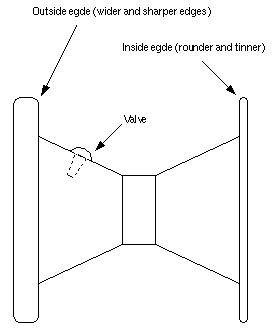 Now identify the smaller edge of the wheel rim. Very often, the inside,
i.e. the side of the wheel rim which does not contain the valve, is smaller
than the outside of the wheel rim. So when choosing your side over which
you will attempt to slip the tire, make sure you choose the smaller one.
Some types of wheel rims (e.g. Douglas wheels), seem to have equally sized
'lips' on both sides. However, when you look closely at the edge of the
inside lip, you can probably see that the lip is made somewhat thinner, and
that its edge is more rounded than the edge of the outside lip. So even in
the case of equally sized lips, the inside lip is still a little easier to
slip the tire over.
Now identify the smaller edge of the wheel rim. Very often, the inside,
i.e. the side of the wheel rim which does not contain the valve, is smaller
than the outside of the wheel rim. So when choosing your side over which
you will attempt to slip the tire, make sure you choose the smaller one.
Some types of wheel rims (e.g. Douglas wheels), seem to have equally sized
'lips' on both sides. However, when you look closely at the edge of the
inside lip, you can probably see that the lip is made somewhat thinner, and
that its edge is more rounded than the edge of the outside lip. So even in
the case of equally sized lips, the inside lip is still a little easier to
slip the tire over.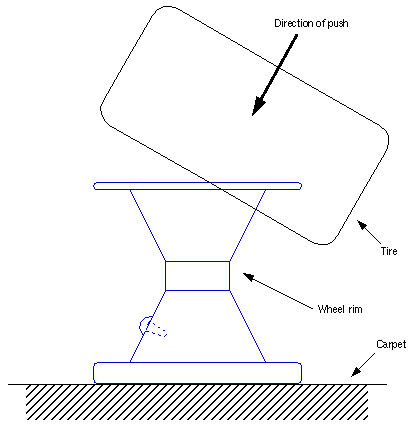 After all this preparation the moment of truth has come. It is now time to
actually mount the tire on the rim. Wearing your gloves, take the tire
out of the oven. It will retain the heat for a while, so you don't have to
rush, but don't waste time either, since eventually it will cool down of
course. Now kneel down, with the rim between your knees. Grab the hot
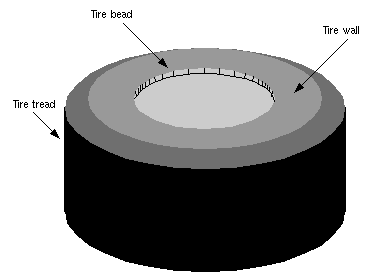
tire very firmly on two sides (similar to a steering wheel). Now press the
tire down onto the rim in an angle, such that the rim makes contact with the
tire bead on two points. At this moment, it is time for brute force,
all technique goes out of the window, and swearing and huffing and puffing
will take over. While you lean with your whole weight onto the tire, the
rim will probably stand at an angle to the floor, gripping with one point
of the outside edge into the carpet. That's OK, since at least it won't slip
around on you, so that you can actually apply all your weight on the tire.
The bottom opening of the tire will be stuck at the widest point of the rim
edge. You might want to apply some pressure on this side or on that side,
trying to get the rubber to slip over that part of the rim. When you press
down on one side, the other side will want to come out again, so you need to
make sure to apply enough pressure on that side to prevent that. If you are
mounting a wider tire, e.g. a rear tire, the relative strength of the tire
tread is less than in a thinner tire. Thus, you might find that the tire
collapses on you, or begins to turn inside out. You can always fix that
later, so keep concentrating on the bottom side of the tire. While you
are struggling, try slightly different angles and position. By doing so
you may suddenly find that the rubber has just stretched enough to let the
widest part of the rim edge pass. At that point the bead will slip right
on the rim. Of course you are now only half finished, since that was just
the bottom tire bead. The upper tire bead (facing you) is still 'outside'
of the rim. So, first apply some more of the lube of your choice to the tire
bead and to the edge of the wheel rim. Now repeat the process, gripping the
tire again very firmly, putting your whole weight behind it. Eventually it
should slip on, just the same as the first bead. Congratulations, you have
now mounted your first tire on a one-piece wheel!
After all this preparation the moment of truth has come. It is now time to
actually mount the tire on the rim. Wearing your gloves, take the tire
out of the oven. It will retain the heat for a while, so you don't have to
rush, but don't waste time either, since eventually it will cool down of
course. Now kneel down, with the rim between your knees. Grab the hot
tire very firmly on two sides (similar to a steering wheel). Now press the
tire down onto the rim in an angle, such that the rim makes contact with the
tire bead on two points. At this moment, it is time for brute force,
all technique goes out of the window, and swearing and huffing and puffing
will take over. While you lean with your whole weight onto the tire, the
rim will probably stand at an angle to the floor, gripping with one point
of the outside edge into the carpet. That's OK, since at least it won't slip
around on you, so that you can actually apply all your weight on the tire.
The bottom opening of the tire will be stuck at the widest point of the rim
edge. You might want to apply some pressure on this side or on that side,
trying to get the rubber to slip over that part of the rim. When you press
down on one side, the other side will want to come out again, so you need to
make sure to apply enough pressure on that side to prevent that. If you are
mounting a wider tire, e.g. a rear tire, the relative strength of the tire
tread is less than in a thinner tire. Thus, you might find that the tire
collapses on you, or begins to turn inside out. You can always fix that
later, so keep concentrating on the bottom side of the tire. While you
are struggling, try slightly different angles and position. By doing so
you may suddenly find that the rubber has just stretched enough to let the
widest part of the rim edge pass. At that point the bead will slip right
on the rim. Of course you are now only half finished, since that was just
the bottom tire bead. The upper tire bead (facing you) is still 'outside'
of the rim. So, first apply some more of the lube of your choice to the tire
bead and to the edge of the wheel rim. Now repeat the process, gripping the
tire again very firmly, putting your whole weight behind it. Eventually it
should slip on, just the same as the first bead. Congratulations, you have
now mounted your first tire on a one-piece wheel!


