| |||||||||||||
I got a piece of hard wood. It does not have to be big nor particularly
fancy. It should be about 2" thick, at least 3" long and 2" wide. The
block of wood I used was a little larger, and I got it simply by sawing off
a piece from a bottom support beam of an unused pallette of a local store.
Make sure, though, that the piece is not thicker than 2" (or the length
of your drill bit).
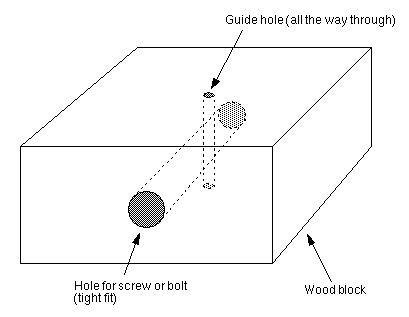
Now drill a hole which is just slightly thinner than the screw or bolt
into the side of the wood-block. Drill it in at least 2", better
3" or more (assuming the screw or bolt is at least that long). If you
want, you can drill all the way through to the other side, but you don't
have to. Make sure you drill the hole nice and orthogonal to the side
of the block. This hole will later firmly hold the screw or bolt you
need to drill.
Now put the drill bit you will use for drilling the safety-wire hole into
your power drill. From the top of the block, drill all the way through
to the bottom. This hole now has to be orthogonal to the previously
drilled hole for the bolt or screw, and it needs to intersect the first
hole towards the end, right in the middle. This will be the guide hole
for the drill bit. Finding the right point at which to drill might be
a little tricky and may require a ruler and some measurements on the
top of the wood-block. Voila, you now have a safety-wire drill tool!
Before you start drilling, you should very scurely fix the block of
wood, now containing the screw or bolt, into a vice. Now insert the
drill-bit for the safety-wire hole into the guide hole. With the power
drill set on low-speed, start to drill your safety-wire hole. The guide
hole should give you enough support so that your drill bit will not wander
too much. Use the usual techniques for drilling safety-wire holes:
This wooden drill guide will be good for a couple of holes. I drilled
5 screws that way, using the same guide hole. The last two were a little
off-center, since the guide hole was loosing its shape, but nevertheless
very usable. So what if you need to drill more screws? Just drill
a new guide hole half an inch or so away from the first guide hole,
and continue. It's really that simple.
I used this method in my living room, using an old phone-book as a
supporting base, kneeling on the book, and holding the wood block fixed
with my knees (not recommended!). Very low tech, but very effective.
If you have any suggestions or feedback about this article, please send
us e-mail at: racing_at_domain-name-of-this-site.com.
Click to visit another section...
(C) Copyright 1998-2000 Resonate Brendel Racing. Do not duplicate or redistribute. racing_at_domain-name-of-this-site.com |



 The screw or bolt you need to drill needs to be inserted into the larger
hole you drilled first. Since the hole was slightly thinner than the
screw or bolt, you will need to force the issue a little. A screw needs
to be screwed in, while a bolt can be hammered in. While doing so, look
through the thinner guide hole. As the screw penetrates deeper into the
block of wood, it will eventually pass the guide hole. You know when
that happens, because your view through the guide hole will be blocked.
Give the screw a few more turns, or hammer the bolt in some more, and
you should now have the end of the screw or bolt a few 16th of an inch
past the guide hole. That should be safe for most safety-wire
applications.
The screw or bolt you need to drill needs to be inserted into the larger
hole you drilled first. Since the hole was slightly thinner than the
screw or bolt, you will need to force the issue a little. A screw needs
to be screwed in, while a bolt can be hammered in. While doing so, look
through the thinner guide hole. As the screw penetrates deeper into the
block of wood, it will eventually pass the guide hole. You know when
that happens, because your view through the guide hole will be blocked.
Give the screw a few more turns, or hammer the bolt in some more, and
you should now have the end of the screw or bolt a few 16th of an inch
past the guide hole. That should be safe for most safety-wire
applications.


